cdexamples/fuxi
# Download sample input data and model weight from https://pan.baidu.com/s/1PDeb-nwUprYtu9AKGnWnNw?pwd=fuxi#list/path=%2FunzipSample_Data.zip
unzipFuXi_EC.zip
# modify the path of model and datasets in examples/fuxi/conf, and inferencepipinstall-rrequirements.txt
pythonpredict.py
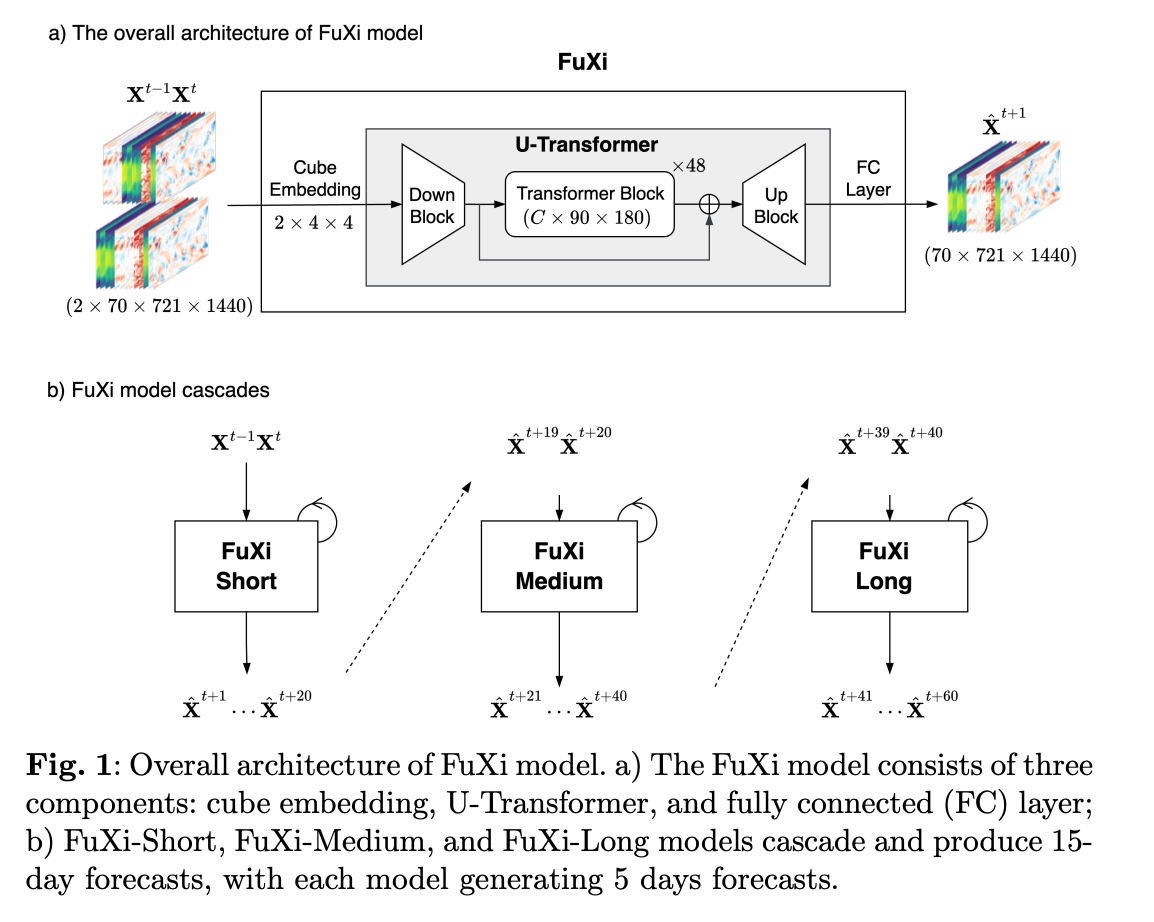
classFuXiPredictor(base.Predictor):"""General predictor for FuXi model. Args: cfg (DictConfig): Running configuration. """def__init__(self,cfg:DictConfig,):print(f"cfg: {cfg}")assertcfg.INFER.engine=="onnx","FuXi engine only supports 'onnx'."super().__init__(pdmodel_path=None,pdiparams_path=None,device=cfg.INFER.device,engine=cfg.INFER.engine,precision=cfg.INFER.precision,onnx_path=cfg.INFER.onnx_path,ir_optim=cfg.INFER.ir_optim,min_subgraph_size=cfg.INFER.min_subgraph_size,gpu_mem=cfg.INFER.gpu_mem,gpu_id=cfg.INFER.gpu_id,max_batch_size=cfg.INFER.max_batch_size,num_cpu_threads=cfg.INFER.num_cpu_threads,)self.log_freq=cfg.log_freq# get input namesself.input_names=[input_node.nameforinput_nodeinself.predictor.get_inputs()]# get output namesself.output_names=[output_node.nameforoutput_nodeinself.predictor.get_outputs()]self.output_dir=cfg.output_dirdefpredict(self,input_data,tembs,global_step,stage,num_step,data,batch_size:int=1)->tuple[np.ndarray,int]:"""Predicts the output of the yinglong model for the given input. Args: input_data(np.ndarray): Atomospheric data of two preceding time steps tembs(np.ndarray): Encoded timestamp. global_step (int): The global step of forecast. stage (int): The stage of forecast model. num_step (int): The number of forecast steps. batch_size (int, optional): Batch size, now only support 1. Defaults to 1. Returns: tuple[np.ndarray, int]: Prediction for one stage and the global step. """ifbatch_size!=1:raiseValueError(f"FuXiPredictor only support batch_size=1, but got {batch_size}")# prepare input dictfor_inrange(0,num_step):input_dict={self.input_names[0]:input_data,self.input_names[1]:tembs[global_step],}# run predictornew_input=self.predictor.run(None,input_dict)[0]output=new_input[:,-1]save_like(output,data,global_step,self.output_dir)print(f"stage: {stage}, global_step: {global_step+1:02d}, output: {output.min():.2f}{output.max():.2f}")input_data=new_inputglobal_step+=1returninput_data,global_step
# Copyright (c) 2025 PaddlePaddle Authors. All Rights Reserved.# Licensed under the Apache License, Version 2.0 (the "License");# you may not use this file except in compliance with the License.# You may obtain a copy of the License at# http://www.apache.org/licenses/LICENSE-2.0# Unless required by applicable law or agreed to in writing, software# distributed under the License is distributed on an "AS IS" BASIS,# WITHOUT WARRANTIES OR CONDITIONS OF ANY KIND, either express or implied.# See the License for the specific language governing permissions and# limitations under the License.importhydraimportnumpyasnpimportpaddleimportpandasaspdimportxarrayasxrfromomegaconfimportDictConfigfromomegaconfimportOmegaConffrompackagingimportversionfromutilimportsave_likefromdeploy.python_inferimportbasefromppsci.utilsimportloggerdeftime_encoding(init_time,total_step,freq=6):init_time=np.array([init_time])tembs=[]foriinrange(total_step):hours=np.array([pd.Timedelta(hours=t*freq)fortin[i-1,i,i+1]])times=init_time[:,None]+hours[None]times=[pd.Period(t,"H")fortintimes.reshape(-1)]times=[(p.day_of_year/366,p.hour/24)forpintimes]temb=np.array(times,dtype=np.float32)temb=np.concatenate([np.sin(temb),np.cos(temb)],axis=-1)temb=temb.reshape(1,-1)tembs.append(temb)returnnp.stack(tembs)classFuXiPredictor(base.Predictor):"""General predictor for FuXi model. Args: cfg (DictConfig): Running configuration. """def__init__(self,cfg:DictConfig,):print(f"cfg: {cfg}")assertcfg.INFER.engine=="onnx","FuXi engine only supports 'onnx'."super().__init__(pdmodel_path=None,pdiparams_path=None,device=cfg.INFER.device,engine=cfg.INFER.engine,precision=cfg.INFER.precision,onnx_path=cfg.INFER.onnx_path,ir_optim=cfg.INFER.ir_optim,min_subgraph_size=cfg.INFER.min_subgraph_size,gpu_mem=cfg.INFER.gpu_mem,gpu_id=cfg.INFER.gpu_id,max_batch_size=cfg.INFER.max_batch_size,num_cpu_threads=cfg.INFER.num_cpu_threads,)self.log_freq=cfg.log_freq# get input namesself.input_names=[input_node.nameforinput_nodeinself.predictor.get_inputs()]# get output namesself.output_names=[output_node.nameforoutput_nodeinself.predictor.get_outputs()]self.output_dir=cfg.output_dirdefpredict(self,input_data,tembs,global_step,stage,num_step,data,batch_size:int=1)->tuple[np.ndarray,int]:"""Predicts the output of the yinglong model for the given input. Args: input_data(np.ndarray): Atomospheric data of two preceding time steps tembs(np.ndarray): Encoded timestamp. global_step (int): The global step of forecast. stage (int): The stage of forecast model. num_step (int): The number of forecast steps. batch_size (int, optional): Batch size, now only support 1. Defaults to 1. Returns: tuple[np.ndarray, int]: Prediction for one stage and the global step. """ifbatch_size!=1:raiseValueError(f"FuXiPredictor only support batch_size=1, but got {batch_size}")# prepare input dictfor_inrange(0,num_step):input_dict={self.input_names[0]:input_data,self.input_names[1]:tembs[global_step],}# run predictornew_input=self.predictor.run(None,input_dict)[0]output=new_input[:,-1]save_like(output,data,global_step,self.output_dir)print(f"stage: {stage}, global_step: {global_step+1:02d}, output: {output.min():.2f}{output.max():.2f}")input_data=new_inputglobal_step+=1returninput_data,global_stepdefinference(cfg:DictConfig):# log paddlepaddle's versionifversion.Version(paddle.__version__)!=version.Version("0.0.0"):paddle_version=paddle.__version__ifversion.Version(paddle.__version__)<version.Version("2.6.0"):logger.warning(f"Detected paddlepaddle version is '{paddle_version}', ""currently it is recommended to use release 2.6 or develop version.")else:paddle_version=f"develop({paddle.version.commit[:7]})"logger.info(f"Using paddlepaddle {paddle_version}")num_steps=cfg.num_stepsstages=["short","medium","long"]# load datadata=xr.open_dataarray(cfg.input_file)total_step=sum(num_steps)init_time=pd.to_datetime(data.time.values[-1])tembs=time_encoding(init_time,total_step)print(f'init_time: {init_time.strftime(("%Y%m%d-%H"))}')print(f"latitude: {data.lat.values[0]} ~ {data.lat.values[-1]}")assertdata.lat.values[0]==90assertdata.lat.values[-1]==-90input_data=data.values[None]step=0fori,num_stepinenumerate(num_steps):print(f"Inference {stages[i]} ...")cfg_path=cfg.fuxi_config_dir+"fuxi_"+stages[i]+".yaml"config=OmegaConf.load(cfg_path)print(f"predictor_cfg: {config}")predictor=FuXiPredictor(config)# run predictorinput_data,step=predictor.predict(input_data=input_data,tembs=tembs,global_step=step,stage=i,num_step=num_step,data=data,)ifstep>total_step:break@hydra.main(version_base=None,config_path="./conf",config_name="fuxi.yaml")defmain(cfg:DictConfig):ifcfg.mode=="infer":inference(cfg)else:raiseValueError(f"cfg.mode should in ['infer'], but got '{cfg.mode}'")if__name__=="__main__":main()