# Copyright (c) 2023 PaddlePaddle Authors. All Rights Reserved.
# Licensed under the Apache License, Version 2.0 (the "License");
# you may not use this file except in compliance with the License.
# You may obtain a copy of the License at
# http://www.apache.org/licenses/LICENSE-2.0
# Unless required by applicable law or agreed to in writing, software
# distributed under the License is distributed on an "AS IS" BASIS,
# WITHOUT WARRANTIES OR CONDITIONS OF ANY KIND, either express or implied.
# See the License for the specific language governing permissions and
# limitations under the License.
import os
import pickle
from typing import Dict
from typing import List
from typing import Tuple
import hydra
import numpy as np
import paddle
from matplotlib import pyplot as plt
from omegaconf import DictConfig
import ppsci
from ppsci.utils import logger
def split_tensors(
*tensors: List[np.array], ratio: float
) -> Tuple[List[np.array], List[np.array]]:
"""Split tensors to two parts.
Args:
tensors (List[np.array]): Non-empty tensor list.
ratio (float): Split ratio. For example, tensor list A is split to A1 and A2.
len(A1) / len(A) = ratio.
Returns:
Tuple[List[np.array], List[np.array]]: Split tensors.
"""
if len(tensors) == 0:
raise ValueError("Tensors shouldn't be empty.")
split1, split2 = [], []
count = len(tensors[0])
for tensor in tensors:
if len(tensor) != count:
raise ValueError("The size of tensor should be same.")
x = int(len(tensor) * ratio)
split1.append(tensor[:x])
split2.append(tensor[x:])
if len(tensors) == 1:
split1, split2 = split1[0], split2[0]
return split1, split2
def predict_and_save_plot(
x: np.ndarray, y: np.ndarray, index: int, solver: ppsci.solver.Solver, plot_dir: str
):
"""Make prediction and save visualization of result.
Args:
x (np.ndarray): Input of test dataset.
y (np.ndarray): Output of test dataset.
index (int): Index of data to visualizer.
solver (ppsci.solver.Solver): Trained solver.
plot_dir (str): Directory to save plot.
"""
min_u = np.min(y[index, 0, :, :])
max_u = np.max(y[index, 0, :, :])
min_v = np.min(y[index, 1, :, :])
max_v = np.max(y[index, 1, :, :])
min_p = np.min(y[index, 2, :, :])
max_p = np.max(y[index, 2, :, :])
output = solver.predict({"input": x}, return_numpy=True)
pred_y = output["output"]
error = np.abs(y - pred_y)
min_error_u = np.min(error[index, 0, :, :])
max_error_u = np.max(error[index, 0, :, :])
min_error_v = np.min(error[index, 1, :, :])
max_error_v = np.max(error[index, 1, :, :])
min_error_p = np.min(error[index, 2, :, :])
max_error_p = np.max(error[index, 2, :, :])
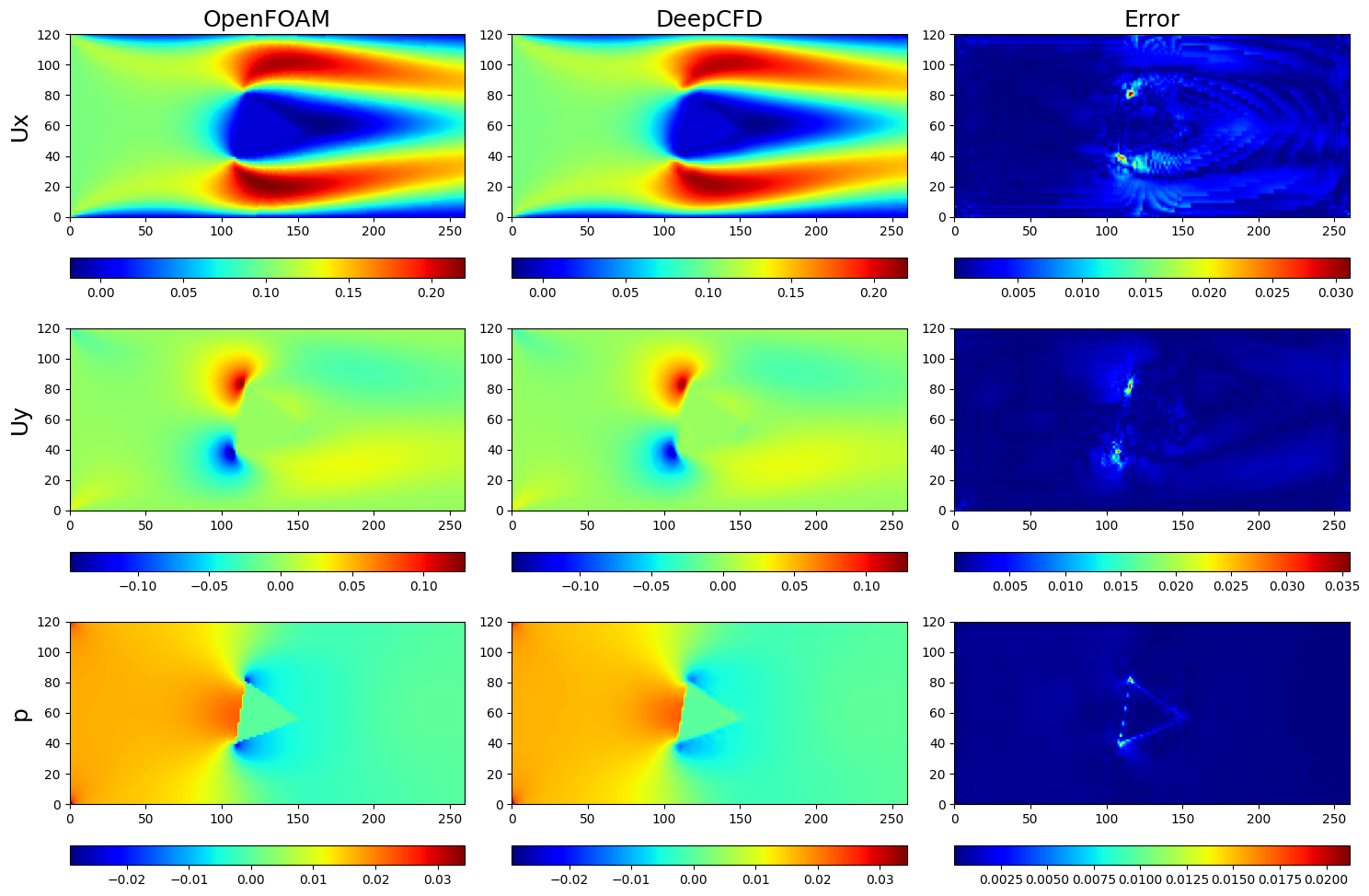
plt.figure()
fig = plt.gcf()
fig.set_size_inches(15, 10)
plt.subplot(3, 3, 1)
plt.title("OpenFOAM", fontsize=18)
plt.imshow(
np.transpose(y[index, 0, :, :]),
cmap="jet",
vmin=min_u,
vmax=max_u,
origin="lower",
extent=[0, 260, 0, 120],
)
plt.colorbar(orientation="horizontal")
plt.ylabel("Ux", fontsize=18)
plt.subplot(3, 3, 2)
plt.title("DeepCFD", fontsize=18)
plt.imshow(
np.transpose(pred_y[index, 0, :, :]),
cmap="jet",
vmin=min_u,
vmax=max_u,
origin="lower",
extent=[0, 260, 0, 120],
)
plt.colorbar(orientation="horizontal")
plt.subplot(3, 3, 3)
plt.title("Error", fontsize=18)
plt.imshow(
np.transpose(error[index, 0, :, :]),
cmap="jet",
vmin=min_error_u,
vmax=max_error_u,
origin="lower",
extent=[0, 260, 0, 120],
)
plt.colorbar(orientation="horizontal")
plt.subplot(3, 3, 4)
plt.imshow(
np.transpose(y[index, 1, :, :]),
cmap="jet",
vmin=min_v,
vmax=max_v,
origin="lower",
extent=[0, 260, 0, 120],
)
plt.colorbar(orientation="horizontal")
plt.ylabel("Uy", fontsize=18)
plt.subplot(3, 3, 5)
plt.imshow(
np.transpose(pred_y[index, 1, :, :]),
cmap="jet",
vmin=min_v,
vmax=max_v,
origin="lower",
extent=[0, 260, 0, 120],
)
plt.colorbar(orientation="horizontal")
plt.subplot(3, 3, 6)
plt.imshow(
np.transpose(error[index, 1, :, :]),
cmap="jet",
vmin=min_error_v,
vmax=max_error_v,
origin="lower",
extent=[0, 260, 0, 120],
)
plt.colorbar(orientation="horizontal")
plt.subplot(3, 3, 7)
plt.imshow(
np.transpose(y[index, 2, :, :]),
cmap="jet",
vmin=min_p,
vmax=max_p,
origin="lower",
extent=[0, 260, 0, 120],
)
plt.colorbar(orientation="horizontal")
plt.ylabel("p", fontsize=18)
plt.subplot(3, 3, 8)
plt.imshow(
np.transpose(pred_y[index, 2, :, :]),
cmap="jet",
vmin=min_p,
vmax=max_p,
origin="lower",
extent=[0, 260, 0, 120],
)
plt.colorbar(orientation="horizontal")
plt.subplot(3, 3, 9)
plt.imshow(
np.transpose(error[index, 2, :, :]),
cmap="jet",
vmin=min_error_p,
vmax=max_error_p,
origin="lower",
extent=[0, 260, 0, 120],
)
plt.colorbar(orientation="horizontal")
plt.tight_layout()
plt.savefig(os.path.join(plot_dir, f"cfd_{index}.png"), bbox_inches="tight")
plt.show()
def train(cfg: DictConfig):
# set random seed for reproducibility
ppsci.utils.misc.set_random_seed(cfg.seed)
# initialize logger
logger.init_logger("ppsci", os.path.join(cfg.output_dir, "train.log"), "info")

# initialize datasets
with open(cfg.DATAX_PATH, "rb") as file:
    x = pickle.load(file)
with open(cfg.DATAY_PATH, "rb") as file:
    y = pickle.load(file)

# split dataset to train dataset and test dataset
train_dataset, test_dataset = split_tensors(x, y, ratio=cfg.SLIPT_RATIO)
train_x, train_y = train_dataset
test_x, test_y = test_dataset
# initialize model
model = ppsci.arch.UNetEx(**cfg.MODEL)
CHANNELS_WEIGHTS = np.reshape(
np.sqrt(
np.mean(
np.transpose(y, (0, 2, 3, 1)).reshape(
(cfg.SAMPLE_SIZE * cfg.X_SIZE * cfg.Y_SIZE, cfg.CHANNEL_SIZE)
)
** 2,
axis=0,
)
),
(1, -1, 1, 1),
)
# define loss
def loss_expr(
    output_dict: Dict[str, np.ndarray],
    label_dict: Dict[str, np.ndarray] = None,
    weight_dict: Dict[str, np.ndarray] = None,
) -> float:
    output = output_dict["output"]
    y = label_dict["output"]
    loss_u = (output[:, 0:1, :, :] - y[:, 0:1, :, :]) ** 2
    loss_v = (output[:, 1:2, :, :] - y[:, 1:2, :, :]) ** 2
    loss_p = (output[:, 2:3, :, :] - y[:, 2:3, :, :]).abs()
    loss = (loss_u + loss_v + loss_p) / CHANNELS_WEIGHTS
    return {"output": loss.sum()}

sup_constraint = ppsci.constraint.SupervisedConstraint(
    {
        "dataset": {
            "name": "NamedArrayDataset",
            "input": {"input": train_x},
            "label": {"output": train_y},
        },
        "batch_size": cfg.TRAIN.batch_size,
        "sampler": {
            "name": "BatchSampler",
            "drop_last": False,
            "shuffle": True,
        },
    },
    ppsci.loss.FunctionalLoss(loss_expr),
    name="sup_constraint",
)
# manually build constraint
constraint = {sup_constraint.name: sup_constraint}
# initialize Adam optimizer
optimizer = ppsci.optimizer.Adam(
    cfg.TRAIN.learning_rate, weight_decay=cfg.TRAIN.weight_decay
)(model)
# manually build validator
eval_dataloader_cfg = {
    "dataset": {
        "name": "NamedArrayDataset",
        "input": {"input": test_x},
        "label": {"output": test_y},
    },
    "batch_size": cfg.EVAL.batch_size,
    "sampler": {
        "name": "BatchSampler",
        "drop_last": False,
        "shuffle": False,
    },
}

def metric_expr(
    output_dict: Dict[str, np.ndarray],
    label_dict: Dict[str, np.ndarray] = None,
    weight_dict: Dict[str, np.ndarray] = None,
) -> Dict[str, float]:
    output = output_dict["output"]
    y = label_dict["output"]
    total_mse = ((output - y) ** 2).sum() / len(test_x)
    ux_mse = ((output[:, 0, :, :] - test_y[:, 0, :, :]) ** 2).sum() / len(test_x)
    uy_mse = ((output[:, 1, :, :] - test_y[:, 1, :, :]) ** 2).sum() / len(test_x)
    p_mse = ((output[:, 2, :, :] - test_y[:, 2, :, :]) ** 2).sum() / len(test_x)
    return {
        "Total_MSE": total_mse,
        "Ux_MSE": ux_mse,
        "Uy_MSE": uy_mse,
        "p_MSE": p_mse,
    }

sup_validator = ppsci.validate.SupervisedValidator(
    eval_dataloader_cfg,
    ppsci.loss.FunctionalLoss(loss_expr),
    {"output": lambda out: out["output"]},
    {"MSE": ppsci.metric.FunctionalMetric(metric_expr)},
    name="mse_validator",
)
validator = {sup_validator.name: sup_validator}
# initialize solver
solver = ppsci.solver.Solver(
    model,
    constraint,
    cfg.output_dir,
    optimizer,
    epochs=cfg.TRAIN.epochs,
    eval_during_train=cfg.TRAIN.eval_during_train,
    eval_freq=cfg.TRAIN.eval_freq,
    seed=cfg.seed,
    validator=validator,
    checkpoint_path=cfg.TRAIN.checkpoint_path,
    eval_with_no_grad=cfg.EVAL.eval_with_no_grad,
)

# train model
solver.train()

# evaluate after finished training
solver.eval()
PLOT_DIR = os.path.join(cfg.output_dir, "visual")
os.makedirs(PLOT_DIR, exist_ok=True)

# visualize prediction after finished training
predict_and_save_plot(test_x, test_y, 0, solver, PLOT_DIR)
def evaluate(cfg: DictConfig):
# set random seed for reproducibility
ppsci.utils.misc.set_random_seed(cfg.seed)
# initialize logger
logger.init_logger("ppsci", os.path.join(cfg.output_dir, "eval.log"), "info")
# initialize datasets
with open(cfg.DATAX_PATH, "rb") as file:
x = pickle.load(file)
with open(cfg.DATAY_PATH, "rb") as file:
y = pickle.load(file)
# split dataset to train dataset and test dataset
train_dataset, test_dataset = split_tensors(x, y, ratio=cfg.SLIPT_RATIO)
train_x, train_y = train_dataset
test_x, test_y = test_dataset
# initialize model
model = ppsci.arch.UNetEx(**cfg.MODEL)
CHANNELS_WEIGHTS = np.reshape(
np.sqrt(
np.mean(
np.transpose(y, (0, 2, 3, 1)).reshape(
(cfg.SAMPLE_SIZE * cfg.X_SIZE * cfg.Y_SIZE, cfg.CHANNEL_SIZE)
)
** 2,
axis=0,
)
),
(1, -1, 1, 1),
)
# define loss
def loss_expr(
output_dict: Dict[str, "paddle.Tensor"],
label_dict: Dict[str, "paddle.Tensor"] = None,
weight_dict: Dict[str, "paddle.Tensor"] = None,
) -> Dict[str, "paddle.Tensor"]:
output = output_dict["output"]
y = label_dict["output"]
loss_u = (output[:, 0:1, :, :] - y[:, 0:1, :, :]) ** 2
loss_v = (output[:, 1:2, :, :] - y[:, 1:2, :, :]) ** 2
loss_p = (output[:, 2:3, :, :] - y[:, 2:3, :, :]).abs()
loss = (loss_u + loss_v + loss_p) / CHANNELS_WEIGHTS
return {"custom_loss": loss.sum()}
# manually build validator
eval_dataloader_cfg = {
"dataset": {
"name": "NamedArrayDataset",
"input": {"input": test_x},
"label": {"output": test_y},
},
"batch_size": cfg.EVAL.batch_size,
"sampler": {
"name": "BatchSampler",
"drop_last": False,
"shuffle": False,
},
}
def metric_expr(
output_dict: Dict[str, "paddle.Tensor"],
label_dict: Dict[str, "paddle.Tensor"] = None,
weight_dict: Dict[str, "paddle.Tensor"] = None,
) -> Dict[str, "paddle.Tensor"]:
output = output_dict["output"]
y = label_dict["output"]
total_mse = ((output - y) ** 2).sum() / len(test_x)
ux_mse = ((output[:, 0, :, :] - test_y[:, 0, :, :]) ** 2).sum() / len(test_x)
uy_mse = ((output[:, 1, :, :] - test_y[:, 1, :, :]) ** 2).sum() / len(test_x)
p_mse = ((output[:, 2, :, :] - test_y[:, 2, :, :]) ** 2).sum() / len(test_x)
return {
"Total_MSE": total_mse,
"Ux_MSE": ux_mse,
"Uy_MSE": uy_mse,
"p_MSE": p_mse,
}
sup_validator = ppsci.validate.SupervisedValidator(
eval_dataloader_cfg,
ppsci.loss.FunctionalLoss(loss_expr),
{"output": lambda out: out["output"]},
{"MSE": ppsci.metric.FunctionalMetric(metric_expr)},
name="mse_validator",
)
validator = {sup_validator.name: sup_validator}
# initialize solver
solver = ppsci.solver.Solver(
model,
output_dir=cfg.output_dir,
seed=cfg.seed,
validator=validator,
pretrained_model_path=cfg.EVAL.pretrained_model_path,
eval_with_no_grad=cfg.EVAL.eval_with_no_grad,
)
# evaluate
solver.eval()
PLOT_DIR = os.path.join(cfg.output_dir, "visual")
os.makedirs(PLOT_DIR, exist_ok=True)
# visualize prediction
predict_and_save_plot(test_x, test_y, 0, solver, PLOT_DIR)
def export(cfg: DictConfig):
model = ppsci.arch.UNetEx(**cfg.MODEL)
solver = ppsci.solver.Solver(
model,
pretrained_model_path=cfg.INFER.pretrained_model_path,
)
from paddle.static import InputSpec
input_spec = [
{
key: InputSpec(
[None, cfg.CHANNEL_SIZE, cfg.X_SIZE, cfg.Y_SIZE], "float32", name=key
)
for key in model.input_keys
},
]
solver.export(input_spec, cfg.INFER.export_path)
print(f"Model has been exported to {cfg.INFER.export_path}")
def predict_and_save_plot_infer(
x: np.ndarray,
y: np.ndarray,
pred_y: np.ndarray,
index: int,
plot_dir: str,
):
"""Make prediction and save visualization of result during inference.
Args:
x (np.ndarray): Input of test dataset.
y (np.ndarray): Ground truth output of test dataset.
pred_y (np.ndarray): Predicted output from inference.
index (int): Index of data to visualize.
plot_dir (str): Directory to save plot.
"""
# Extract the true and predicted values for each channel
u_true = y[index, 0, :, :]
v_true = y[index, 1, :, :]
p_true = y[index, 2, :, :]
u_pred = pred_y[index, 0, :, :]
v_pred = pred_y[index, 1, :, :]
p_pred = pred_y[index, 2, :, :]
# Compute the absolute error between true and predicted values
error_u = np.abs(u_true - u_pred)
error_v = np.abs(v_true - v_pred)
error_p = np.abs(p_true - p_pred)
# Calculate the min and max values for each channel
min_u, max_u = u_true.min(), u_true.max()
min_v, max_v = v_true.min(), v_true.max()
min_p, max_p = p_true.min(), p_true.max()
min_error_u, max_error_u = error_u.min(), error_u.max()
min_error_v, max_error_v = error_v.min(), error_v.max()
min_error_p, max_error_p = error_p.min(), error_p.max()
# Start plotting
plt.figure(figsize=(15, 10))
# Plot Ux channel (True, Predicted, and Error)
plt.subplot(3, 3, 1)
plt.title("OpenFOAM Ux", fontsize=18)
plt.imshow(
np.transpose(u_true),
cmap="jet",
vmin=min_u,
vmax=max_u,
origin="lower",
extent=[0, 260, 0, 120],
)
plt.colorbar(orientation="horizontal")
plt.ylabel("Ux", fontsize=18)
plt.subplot(3, 3, 2)
plt.title("DeepCFD Ux", fontsize=18)
plt.imshow(
np.transpose(u_pred),
cmap="jet",
vmin=min_u,
vmax=max_u,
origin="lower",
extent=[0, 260, 0, 120],
)
plt.colorbar(orientation="horizontal")
plt.subplot(3, 3, 3)
plt.title("Error Ux", fontsize=18)
plt.imshow(
np.transpose(error_u),
cmap="jet",
vmin=min_error_u,
vmax=max_error_u,
origin="lower",
extent=[0, 260, 0, 120],
)
plt.colorbar(orientation="horizontal")
# Plot Uy channel (True, Predicted, and Error)
plt.subplot(3, 3, 4)
plt.imshow(
np.transpose(v_true),
cmap="jet",
vmin=min_v,
vmax=max_v,
origin="lower",
extent=[0, 260, 0, 120],
)
plt.colorbar(orientation="horizontal")
plt.ylabel("Uy", fontsize=18)
plt.subplot(3, 3, 5)
plt.imshow(
np.transpose(v_pred),
cmap="jet",
vmin=min_v,
vmax=max_v,
origin="lower",
extent=[0, 260, 0, 120],
)
plt.colorbar(orientation="horizontal")
plt.subplot(3, 3, 6)
plt.imshow(
np.transpose(error_v),
cmap="jet",
vmin=min_error_v,
vmax=max_error_v,
origin="lower",
extent=[0, 260, 0, 120],
)
plt.colorbar(orientation="horizontal")
# Plot pressure channel p (True, Predicted, and Error)
plt.subplot(3, 3, 7)
plt.imshow(
np.transpose(p_true),
cmap="jet",
vmin=min_p,
vmax=max_p,
origin="lower",
extent=[0, 260, 0, 120],
)
plt.colorbar(orientation="horizontal")
plt.ylabel("p", fontsize=18)
plt.subplot(3, 3, 8)
plt.imshow(
np.transpose(p_pred),
cmap="jet",
vmin=min_p,
vmax=max_p,
origin="lower",
extent=[0, 260, 0, 120],
)
plt.colorbar(orientation="horizontal")
plt.subplot(3, 3, 9)
plt.imshow(
np.transpose(error_p),
cmap="jet",
vmin=min_error_p,
vmax=max_error_p,
origin="lower",
extent=[0, 260, 0, 120],
)
plt.colorbar(orientation="horizontal")
plt.tight_layout()
plt.savefig(os.path.join(plot_dir, f"cfd_{index}.png"), bbox_inches="tight")
plt.close()
def inference(cfg: DictConfig):
from deploy.python_infer import pinn_predictor
# Load test dataset from serialized files
with open(cfg.DATAX_PATH, "rb") as file:
x = pickle.load(file)
with open(cfg.DATAY_PATH, "rb") as file:
y = pickle.load(file)
# Split data into training and test sets
_, test_dataset = split_tensors(x, y, ratio=cfg.SLIPT_RATIO)
test_x, test_y = test_dataset
input_dict = {cfg.MODEL.input_key: test_x}
# Initialize the PINN predictor model
predictor = pinn_predictor.PINNPredictor(cfg)
# Run inference and get predictions
output_dict = predictor.predict(input_dict, batch_size=cfg.INFER.batch_size)
# Handle model's output key structure
actual_output_key = cfg.MODEL.output_key
output_keys = (
actual_output_key
if isinstance(actual_output_key, (list, tuple))
else [actual_output_key]
)
if len(output_keys) != len(output_dict):
raise ValueError(
"The number of output_keys does not match the number of output_dict keys."
)
# Map model output keys to values
output_dict = {
origin: value for origin, value in zip(output_keys, output_dict.values())
}
concat_output = output_dict[actual_output_key]
if concat_output.ndim != 4 or concat_output.shape[1] != 3:
raise ValueError(
f"Unexpected shape of '{actual_output_key}': {concat_output.shape}. Expected (batch_size, 3, x_size, y_size)."
)
try:
# Extract Ux, Uy, and pressure from the predicted output
u_pred = concat_output[:, 0, :, :] # Ux
v_pred = concat_output[:, 1, :, :] # Uy
p_pred = concat_output[:, 2, :, :] # p
except IndexError as e:
print(f"Error in splitting '{actual_output_key}': {e}")
raise
# Combine the predictions into one array for further processing
pred_y = np.stack([u_pred, v_pred, p_pred], axis=1)
PLOT_DIR = os.path.join(cfg.output_dir, "infer_visual")
os.makedirs(PLOT_DIR, exist_ok=True)
# Visualize and save the first five predictions
for index in range(min(5, pred_y.shape[0])):
predict_and_save_plot_infer(test_x, test_y, pred_y, index, PLOT_DIR)
print(f"Inference completed. Results are saved in {PLOT_DIR}")
@hydra.main(version_base=None, config_path="./conf", config_name="deepcfd.yaml")
def main(cfg: DictConfig):
if cfg.mode == "train":
train(cfg)
elif cfg.mode == "eval":
evaluate(cfg)
elif cfg.mode == "export":
export(cfg)
elif cfg.mode == "infer":
inference(cfg)
else:
raise ValueError(
f"cfg.mode should in ['train', 'eval', 'export', 'infer'], but got '{cfg.mode}'"
)
if __name__ == "__main__":
main()